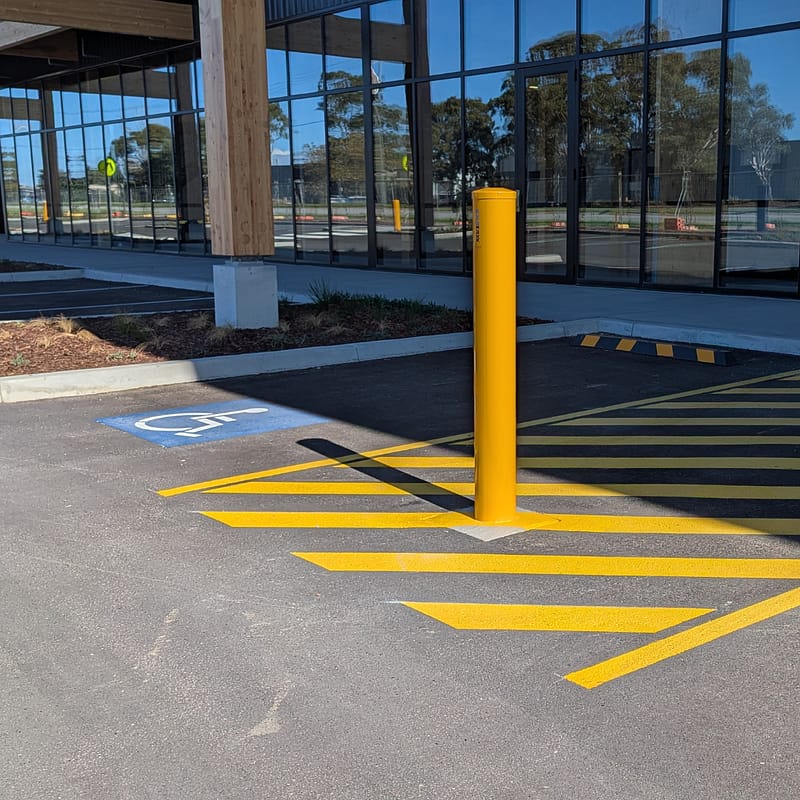
Disabled Car Park Bollards – Installed Properly or Not at All
There’s a dangerous myth floating around the industry:
“You can just install fixed bollards straight into asphalt.”
You can’t.
And in disabled car parks, cutting corners is not just poor workmanship. Iit’s a serious safety risk.
Creating safe, accessible public spaces isn’t optional, it’s a legal and moral obligation. At Supamaxx, we supply bollards designed to assist projects in meeting accessibility requirements under the Disability Discrimination Act 1992 (DDA) and associated standards such as AS 1428.1.
Whether you’re delivering a shopping centre upgrade, commercial fit-out, hospital redevelopment, school project or government infrastructure works, specifying the correct bollards is critical to ensuring pedestrian safety without restricting accessibility.
Why Asphalt Alone Is Not Acceptable
Asphalt is a flexible pavement. In Australian conditions, especially during summer:
It softens in heat
It has no structural load-bearing capacity
It provides poor lateral restraint
It can deform under impact or pressure
If a fixed bollard is simply cored into asphalt:
It can lean over time
It can be pushed over
The surrounding surface can break away
It becomes a trip hazard
Pedestrian protection is compromised
When the bollard moves, your security is gone.
For disability access areas, that is unacceptable.
The Correct Method – Concrete Footing Installation
If the surface is asphalt, the correct approach is:
Excavate and remove the asphalt section
Dig down to suitable depth
Install a heavy-duty reinforced concrete footing
Set the bollard into the concrete and allow it to cure
Reinstate the surrounding asphalt if required
This creates:
Proper structural lock-in
Lateral stability
Long-term durability
Genuine impact resistance
Compliance integrity
The bollard is no longer relying on softened pavement, it’s anchored into a solid structural base.
If aesthetics are a concern, the concrete footing can be finished and coated to closely match the surrounding asphalt for a clean, uniform appearance.
Why This Matters in Disabled Car Parks
Disabled car park bollards are installed to:
Protect pedestrian access paths
Prevent vehicle encroachment
Support DDA-compliant layouts
Safeguard vulnerable users
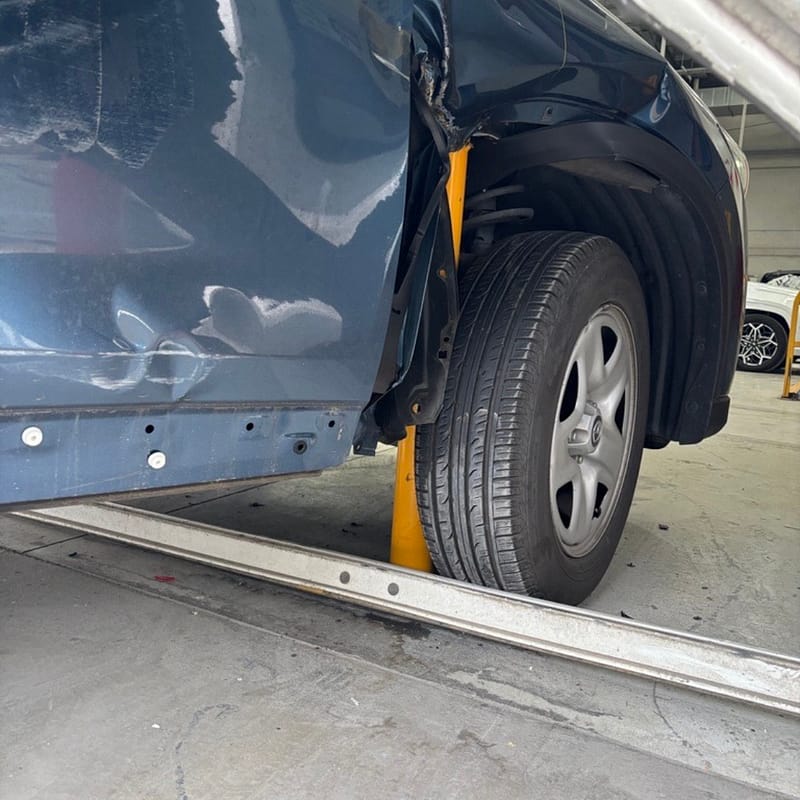
If those bollards can be pushed over because someone saved a few dollars on installation, you’re left with:
A failed safety control
Potential liability exposure
A non-compliant outcome
A serious risk to the public
Bottom Line
If it’s asphalt… we dig it out!
We install a heavy-duty concrete footing to properly lock the bollard into place.
Because pedestrian safety isn’t something you “hope” holds up on a hot day.